Kitchen cabinet woodworking is more than building boxes that look nice. It’s the difference between a kitchen that seems bolted on and one that feels like it belongs. I’ve been a cabinetmaker for 19 years, and I still think the best kitchens are the ones where every panel, drawer, and hinge was chosen for a specific house.
If you’re planning new cabinets, you need to understand what happens inside a real shop before the delivery truck shows up. That means knowing the materials, the joinery, and the costs. That knowledge will save you from overpaying for pretty faces and give you the vocabulary to ask the right questions.
Start With the Right Wood
Every custom cabinet starts with the material. The best carcases are 3/4-inch furniture-grade plywood with a hardwood veneer core, not particleboard or MDF. Baltic birch is a favorite for drawer boxes and interior parts. It’s strong, stable, and holds screws well. For doors and drawer fronts, we use solid hardwood — maple, white oak, walnut, or cherry. Each species behaves differently. Oak has open grain that can look busy. Maple paints beautifully but yellows under some finishes. Walnut is stable, dark, and costly.
The plywood grade matters as much as the species. We use AA or A1 plywood on any face that will be seen. That means the veneer is sanded, the core has no voids, and there are no patch marks. Big-box stores sell utility-grade plywood for less, but it doesn’t belong in a kitchen you’ll look at daily for 20 years. Matching the material to your home’s humidity is part of the job.
That’s where kitchen cabinet woodworking moves from a material conversation to an assembly conversation.

Joinery Is What Separates a Cabinet from a Box
Kitchen cabinet woodworking really shows up in the joints. A good drawer box is held together with half-blind dovetails, which lock the sides to the front without any pin showing on the face. That joint takes time to cut, but it’s the reason a drawer from a custom shop doesn’t rack and fall apart after six years of use. Mortise and tenon joints work well for face frames and doors. They’re stronger than dowels and more forgiving than biscuits.
A less visible detail is how the cabinet boxes are joined at the corners. Some shops use a dado joint, which is fine for hidden carcases. For visible ends, we use a flush joint with dowels or a structural screw with a wood cap. The point is restraint: no showy joinery where nobody will look, but no joints that rely on caulk and paint to stay square.
How a Shop Builds Your Kitchen
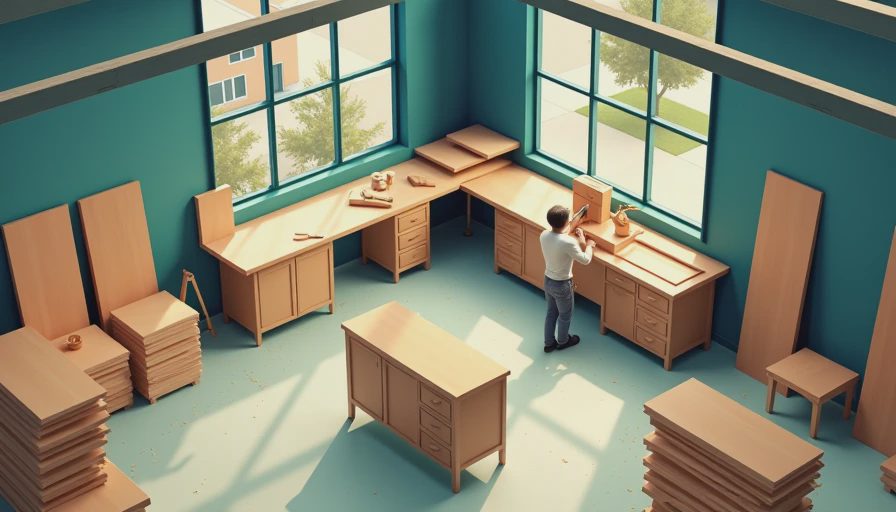
When you order from our shop, the process starts with shop drawings, not a CNC machine. We measure your space, model every run in 3D, and turn that model into cut lists the floor crew follows. The CNC cuts dados and drill patterns precisely; the bench cabinetmakers handle the joinery, sanding, and assembly. That split between automated cutting and hand-fitted assembly is why the cabinets fit within a 1/16-inch tolerance.
Every drawer gets soft-close under-mount glides, usually from Blum or Hettich. Hinges, too. Those brands build tight mechanical tolerances and make replaceable parts. If a hinge wears out in 15 years, you order the same one and swap it. Cheap hinges aren’t made to be replaced, so the door can outlive the hardware.
Finishing is the last stage and the one homeowners underestimate. A professional spray finish cures to a hardness you can’t get from a brush. We use conversion varnish, a two-part finish that resists water, heat, and household chemicals. That’s the finish that lets you wipe grease off a cabinet face with a damp cloth and not worry about streaks. A hand-wiped oil finish doesn’t hold up in a kitchen.
What Custom Kitchen Cabinetry Actually Costs
Let’s talk numbers. Kitchen cabinet woodworking ranges widely by region, wood species, and shop. For a typical 10-by-10 kitchen in Western Washington, a full custom shop will charge between $25,000 and $45,000 for a complete set with installation. That includes plywood carcases, solid wood doors, dovetailed drawers, soft-close hardware, and a sprayed finish. Semi-custom lines from a local millwork supplier can run $10,000 to $20,000 for the same box count, but you give up customization and often interior fittings.
Is custom worth the premium? If your kitchen has standard sizes and a simple layout, a good semi-custom line will look great. But if you have odd corners, a wavy plaster wall, or a pantry that needs a specific pull-out system, custom work is the way to use every inch. That’s not a luxury — it’s geometry. A 2-inch dead space behind a refrigerator may not sound like much, but multiply it by 12 and you’ve lost a drawer.
Questions to Ask Before You Hire
Before you sign a contract, ask about the plywood grade, whether the drawers are dovetailed, which hardware brands are spec’d, how the finish is applied, and if you can see a recent project with a similar layout. The answers reveal how a shop thinks about kitchen cabinet woodworking.
The best kitchens I’ve built weren’t the ones with the most expensive stone. In one Ballard project, a 17-inch gap between a window and the refrigerator became a pull-out spice rack. No catalog cabinet can do that.
So when you weigh new cabinets, look past the door style. Consider who builds them, how the boxes are joined, and what finish will meet your family’s routine. Good kitchen cabinet woodworking doesn’t happen by accident. It happens in a shop where materials are chosen with intent, joints are cut with care, and no one skips the sanding. That’s what you’re paying for.




No comments yet — grab the first one.