The Replacement Cycle Trap
Freestanding furniture looks cheaper on the sticker. That’s the trap. The real cost is the cycle: you buy a piece, it wears, you replace it. Custom cabinetry stops that cycle. Over a decade, the math swings hard in favor of built-ins — and most people never run the numbers.
Why Freestanding Furniture Fails on a Clock
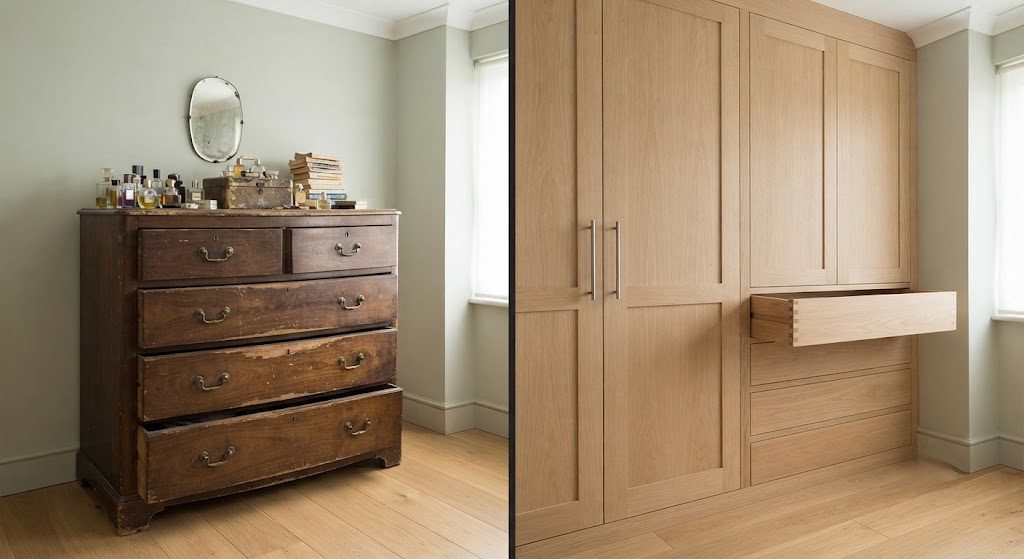
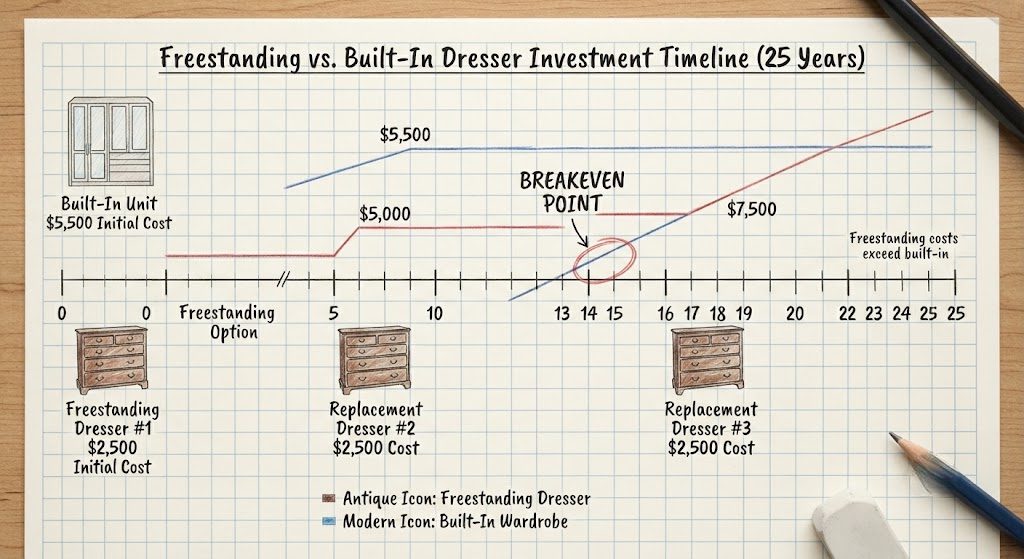
A mid-range dresser — $2,500 at retail — is built on a time budget. The drawer boxes are stapled particleboard; the glides are nylon rollers that bind after five years; the veneer chips at the corners the first time you move it. In a household with kids and daily use, it’s tired by year seven and embarrassing by year ten. Replace it, and you’ve spent $5,000. Replace it again around year 20, and you’re at $7,500. Three purchases in 25 years: $7,500 total, not adjusted for inflation.
Now compare a built-in wardrobe of the same storage volume. A 6-foot-wide, floor-to-ceiling maple cabinet with a ¾-inch plywood carcase, solid-wood dovetailed drawers, and Blum soft-close slides runs about $6,500, installed. At year ten, the freestanding route has cost $5,000 and the piece is mid-collapse. The built-in still operates like new, needing nothing. By year 20, the replacement cycle has pushed freestanding spending past the built-in’s initial price. By year 25, the built-in is $1,000 cheaper — and you haven’t owned a sagging drawer in two decades.
The Equation That Changes the Quote
Clients ask me, “Is the built-in worth it?” I show them the breakeven year. For a typical wardrobe, it’s between year nine and year fourteen, depending on the materials and hardware. After that, the math turns merciless: every additional year the built-in functions without replacement is pure savings against the freestanding cycle. Add a modest 3% inflation on future dresser purchases, and the gap widens faster.
Leo Chase’s Wardrobe That Became a Statement
Leo Chase ran the numbers when we quoted a walk-in closet system. His previous setup was two IKEA PAX frames and a standalone three-drawer chest — about $1,800 total, replaced every six years as the laminate peeled and the hinges failed. We built a wall-to-wall maple system with 16 dovetailed drawers, tilted shoe shelves, and valet rods at exactly his shirt length. The bid was $7,200. At the time, Leo hesitated. Then he added up 25 years of PAX replacements: four cycles at $1,800 each (with inflation assumptions) came to over $9,000. The built-in saved him money and gave him drawers that glide shut instead of slamming. That’s not an upgrade — it’s a liability swap.
Extend the logic beyond the wardrobe. A freestanding pantry cabinet costs $800 and lasts eight years before the adjustable shelves bow and the doors misalign. A floor-to-ceiling built-in pantry, fully adjustable and anchored to the studs, costs $3,200 and lasts the life of the house. The breakeven lands at year 19, but the daily experience changes on day one: no rattling cans every time you shut the door, no inch of wasted space beside the wall.
Built-ins aren’t an expense you absorb — they’re a recurring cost you stop paying. When the breakeven year passes, your house simply keeps a well-made cabinet, and you keep the difference.



No comments yet — grab the first one.