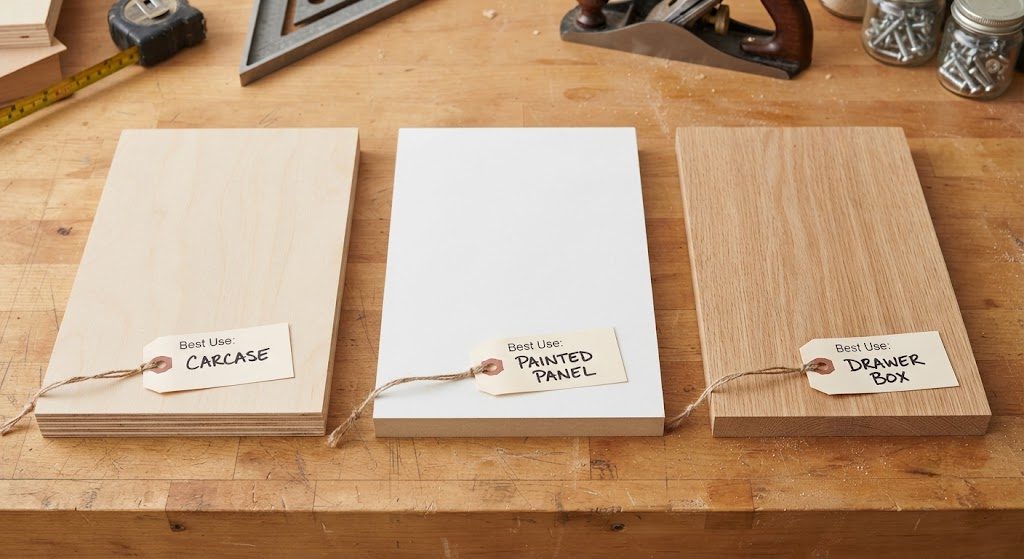
The Material Trio
A custom cabinet is not one material. It’s a composite of three — plywood, MDF, and solid wood — each chosen for a specific job. Use solid wood where you shouldn’t, and your cabinet will warp before its first winter. Use MDF for a drawer box, and the bottom will blow out under the weight of a cast-iron skillet. Matching the material to the function is the single most cost-effective decision in a cabinet build.
Plywood: The Backbone of the Box
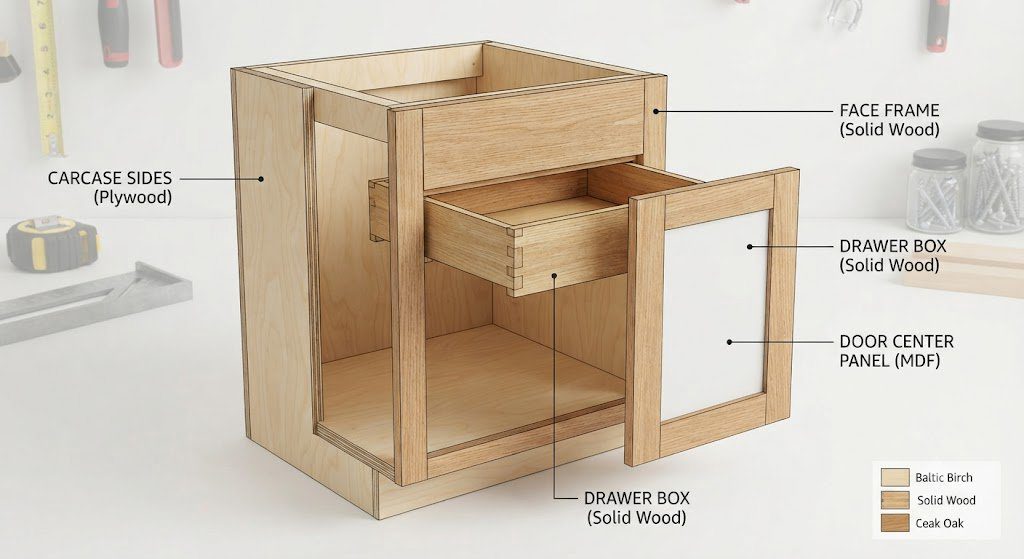
The carcase — the cabinet’s structural box — takes side loads, shelf weight, and decades of door slams. Baltic birch or furniture-grade maple plywood, ¾-inch thick, with 9 to 13 plies, is the standard for a reason. It holds screws without stripping, resists racking, and expands and contracts less than solid wood across its width. A plywood carcase with a quality veneer core will outlast the house if kept dry. In a kitchen, where humidity swings from a simmering stockpot to a dry winter afternoon, plywood is non-negotiable.
MDF: The Secret of a Perfect Paint Job
Medium-density fiberboard gets a bad reputation from flat-pack furniture, but in a custom shop it’s the best substrate for a painted finish. Its surface is dead flat and grain-free, which means no ghosting — the faint grain pattern that can telegraph through paint on solid wood doors after a few seasonal cycles. For a shaker-style painted door, an MDF center panel with a solid maple frame gives you a stable, smooth surface that won’t crack at the joints. MDF is also ideal for interior cabinet liners and fixed shelves in a pantry: flat, cleanable, and cheaper than plywood.
Solid Wood: Where Grain Earns Its Keep
Solid hardwood — maple, walnut, cherry, rift-sawn white oak — belongs where you see and touch it. Face frames, door frames, drawer fronts, and most importantly, drawer boxes. A drawer box built from solid maple with dovetailed corners and a ¼-inch plywood bottom will carry a load of pots and pans for 30 years without complaint. I’ve seen particleboard drawers fail in five years under the same load. Solid wood also shapes itself to its environment — expect some seasonal movement — which is exactly why you never capture it in a rigid frame without room to breathe.
The Cost of Using the Wrong Material
A homeowner insisting on a solid walnut carcase might feel premium, but it’s a $1,200 mistake. Solid wood sides will cup across the width of a 24-inch-deep cabinet, pulling the back out of square. Within two years the doors won’t align. Worse, you’ve spent double the material cost for a part no one sees. Leo Chase came to us after a contractor built a bathroom vanity entirely from solid alder without accounting for moisture — the stiles swelled, the drawer faces seized, and the fix cost more than the original work. We rebuilt it with a plywood carcase, alder face frame, and an MDF door panel for paint. The material bill was $400 less, and the cabinet hasn’t moved a millimeter in three years.
Use this rule: if it’s structural and hidden, it’s plywood. If it’s painted and flat, it’s MDF. If you touch it, see it, or pull on it, it’s solid wood. Follow that, and you’ll spend money exactly where it changes the cabinet’s life — and not a dollar on the wrong problem.
No comments yet — grab the first one.