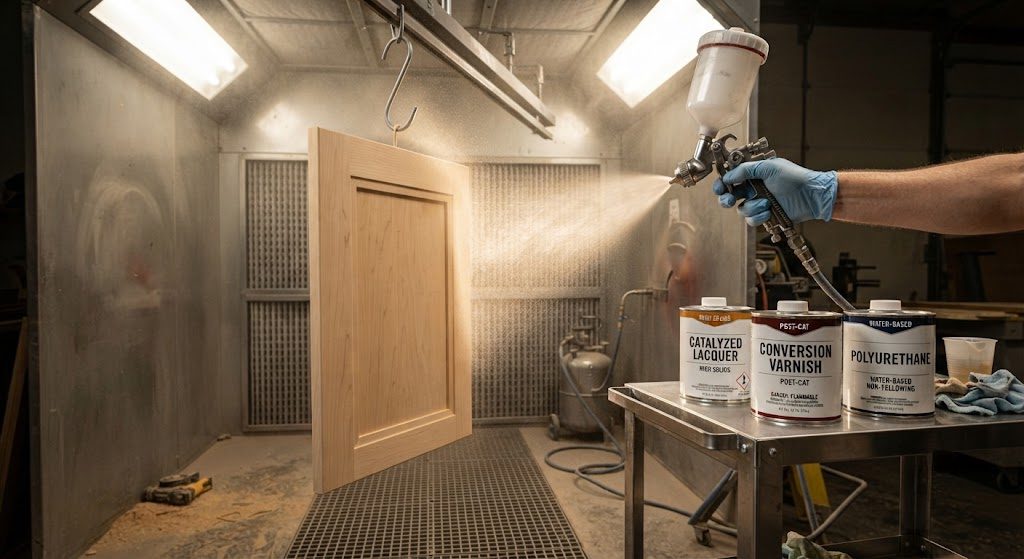
The Finish Is the Armor
The joint holds the cabinet together. The finish keeps the world off the wood. Moisture, hand oils, UV light, cleaning sprays — a cabinet door faces more abuse than any piece of furniture in the house except the floor. Yet most homeowners spend hours choosing a door profile and zero minutes asking what gets sprayed on it. That's a mistake. The right finish adds years of service life. The wrong one subtracts them.
Catalyzed Lacquer: The Shop Workhorse
Catalyzed lacquer is a two-part finish — lacquer plus an acid catalyst — that cures by chemical reaction rather than solvent evaporation alone. It sprays thin, builds fast, and can be sanded and polished to a glass-smooth piano finish within hours. In a production shop, speed matters: catalyzed lacquer lets us spray three coats in a single day, sand between coats, and deliver doors that are hard, clear, and ready to handle. It resists household chemicals well and doesn't yellow over time the way nitrocellulose lacquer does.
The trade-off is heat and moisture sensitivity. A catalyzed lacquer finish on a bathroom vanity that sees daily steam will eventually blush — a cloudy white haze that signals moisture penetration. I don't spec it for bathrooms or exterior-adjacent mudrooms. Everywhere else — kitchens, pantries, built-in bookcases — it's my default paint-grade topcoat.
Conversion Varnish: The Heavyweight
Conversion varnish is catalyzed lacquer's tougher cousin. It uses a melamine-based resin that cross-links into an exceptionally hard, chemical-resistant film. In a kitchen where cabinets get degreased with spray cleaners, or a bathroom vanity surrounded by hair products and acetone, conversion varnish is the correct call. It handles heat up to 200 degrees Fahrenheit, resists mustard stains, and won't lift when a wet sponge sits against the toe kick. The downside is application: it's a two-component mix with a pot life of about 4 hours, so the shop can't batch-spray it as efficiently. Labor runs 15% to 20% higher than catalyzed lacquer. For the rooms that eat finishes alive, it's worth it.
Polyurethane: The Misunderstood Option
Polyurethane gets recommended by painters who don't spray cabinets for a living. It's a single-component, moisture-cured finish that's genuinely excellent on floors — it's flexible, abrasion-resistant, and handles foot traffic. On a vertical cabinet door, that flexibility becomes a liability. Polyurethane stays slightly soft, which means dust clings to it, and stacked plates can leave compression marks in the film. It also amber dramatically over time, turning a white painted cabinet a warm cream within three years. If you want consistent white cabinets, polyurethane is the wrong call. I use it for one application only: interior wood doors and trim that need to match a floor's sheen and tone.
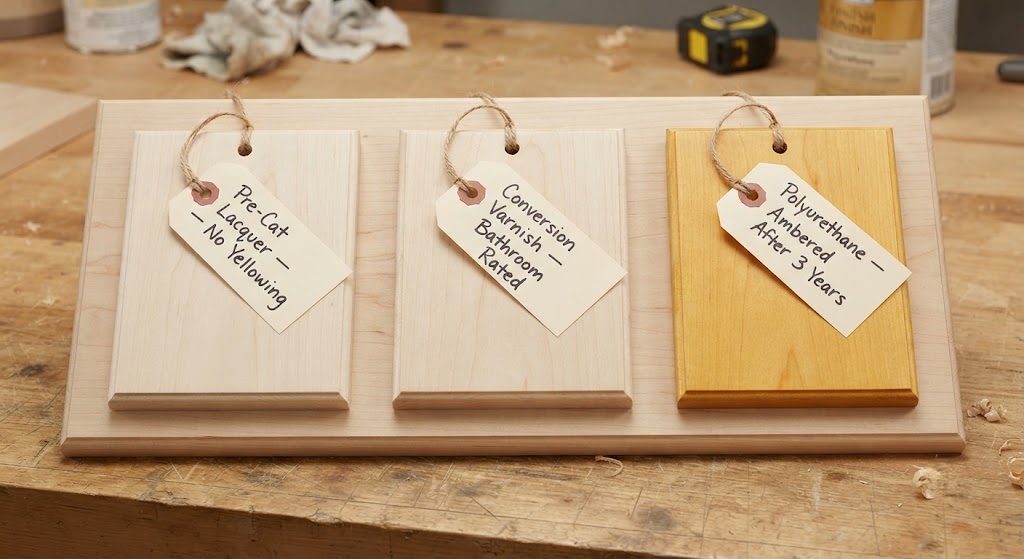
The Finish-by-Room Decision Matrix
Leo Chase had his kitchen cabinets sprayed with a standard pre-catalyzed lacquer. That was correct. But the contractor used the same finish on the master bathroom vanity — and within 18 months, the lower doors had blushed around the handles where wet hands made contact. We stripped and re-sprayed the vanity in conversion varnish for $1,100. Had we spec'd correctly from the start, the upcharge would have been $400. The lesson: bathrooms get conversion varnish, kitchens get catalyzed lacquer or conversion varnish depending on abuse level, and built-in bookcases in dry living spaces get catalyzed lacquer. Polyurethane stays on the floor.
Specify the finish in writing. A cabinet quote that says "clear coat" without naming the product and sheen is a blank check for the cheapest option the shop can spray. Ask for the manufacturer and product line — ML Campbell, Chemcraft, and Axalta are the three names you want to see on a cut sheet. If the quote won't name the finish, find a different shop.
No comments yet — grab the first one.