The 20% Line Item
When a client reviews a cabinet shop quote, the hardware line item almost always raises an eyebrow. Blum soft-close drawer slides, clip-top hinges with integrated dampers, push-to-open mechanisms — the total can land between 15% and 22% of the cabinet package. It feels high. But hardware is the one thing in your kitchen or closet that moves every single day, multiple times a day, under load. If it fails, the entire cabinet becomes a daily source of irritation. Spend here.
Side-Mount vs. Undermount Slides
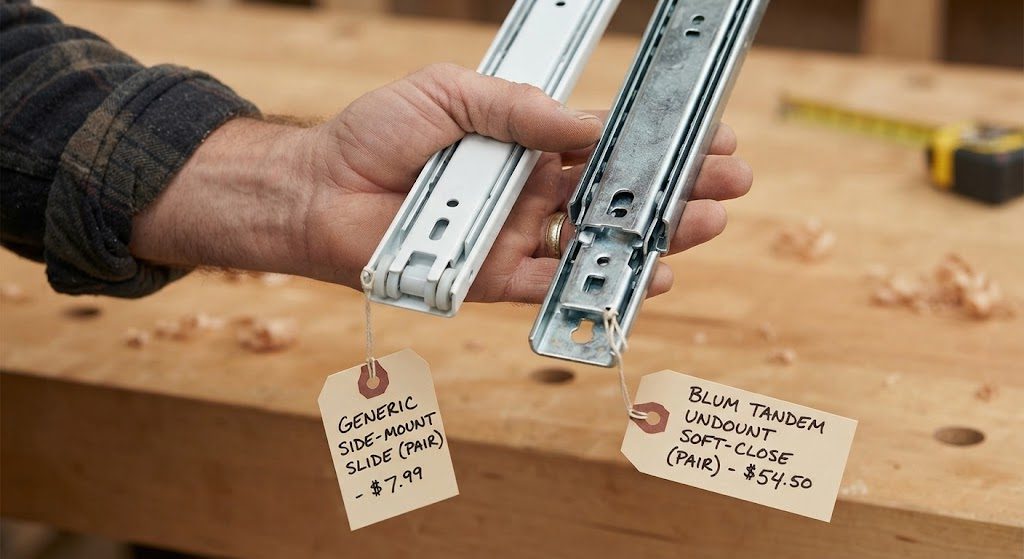
Side-mount slides bolt to the drawer box sides and run on nylon or ball-bearing rollers. They're visible when the drawer opens, they rattle, and they max out at about 75 pounds of load before the bottom drawer sags. A pair of generic side-mount slides costs $6. They belong in garage workshop cabinets, not in a kitchen drawer holding a stack of plates.
Undermount slides — Blum Tandem or Grass Dynapro — mount beneath the drawer and disappear. The soft-close mechanism is integrated into the slide body, so the drawer glides shut with a whisper regardless of how hard it's pushed. Load rating on a standard Blum 563 undermount is 100 pounds dynamic, and they run about $25 per pair. Over 25 years of daily use, that's a penny per open-close cycle. The difference in feel is the difference between a sliding barn door and a vault door.
Hinges: The Hinge That Outlasts the Door
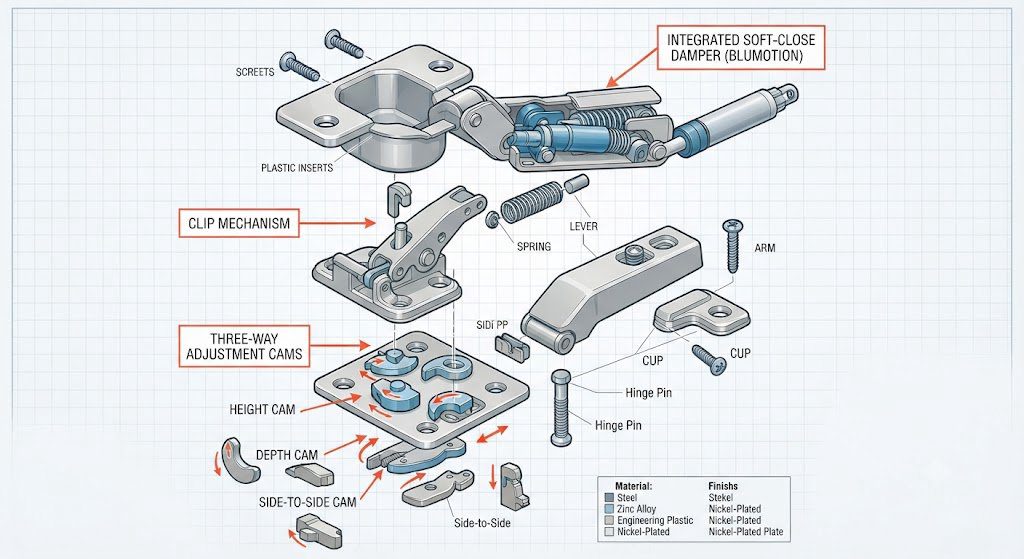
A cabinet door swings open and shut 10 to 20 times a day. A hinge with a cheap spring mechanism will fail somewhere around cycle 40,000 — about six years in a busy kitchen. Blum Clip-Top BLUMOTION hinges are rated for 200,000 cycles, which works out to over 30 years of hard use. They run about $12 per hinge, compared to $3 for a generic European hinge. For a kitchen with 20 doors, that's a $720 delta. Over 30 years, it's $24 a year for doors that never bounce, never slam, and never droop on their plates.
Where to Save on Hardware
Not every hinge and slide in the house needs a Blum part number. Trash pull-outs that ride on heavy-duty ball-bearing slides don't benefit from soft-close — the bin weight does the damping. Fixed shelves in a pantry are exactly that: fixed. Drawers in a kid's playroom built-in that will hold board games and craft supplies can run on a mid-tier Grass Nova slide ($16 per pair) without anyone noticing the difference. The rule is simple: if it gets daily use under weight, buy the best. If it sits behind a door holding seasonal linens, the mid-grade hardware is fine.
Leo Chase learned this the hard way when a contractor spec'd generic compact hinges on his pantry doors. Within 18 months the doors wouldn't stay closed, the adjustment cams had stripped, and the constant slamming had loosened the hinge screws in the MDF. We retrofitted 14 doors with Blum Clip-Top hinges for $280. Two years later, every door hangs perfectly, closes quietly, and hasn't required a single adjustment. The original generic hinges saved Leo about $90 on the initial build. The retrofit cost him triple the savings and a year and a half of aggravation.
Hardware is the part of a cabinet you interact with. You don't touch the dovetail in the drawer corner; you touch the slide that delivers the drawer to your hand. Spend accordingly.
No comments yet — grab the first one.