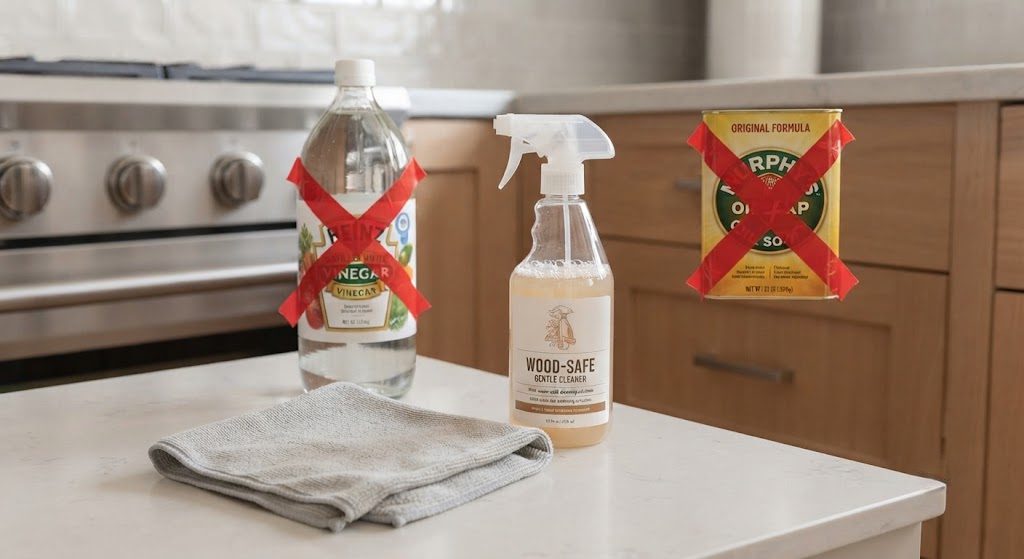
The Cleaning Products That Do the Most Damage
Every client asks the same question at the final walkthrough: "What should I clean these with?" The better question is what not to use. After 19 years of seeing cabinets come back for refinishing, I can trace the damage to three repeat offenders — all of them popular, widely recommended, and absolutely wrong for wood cabinetry. The common thread is that they feel like "natural" or "deep-cleaning" solutions, but they work by degrading the finish film, not cleaning it.
Vinegar: The Acid That Eats Your Topcoat
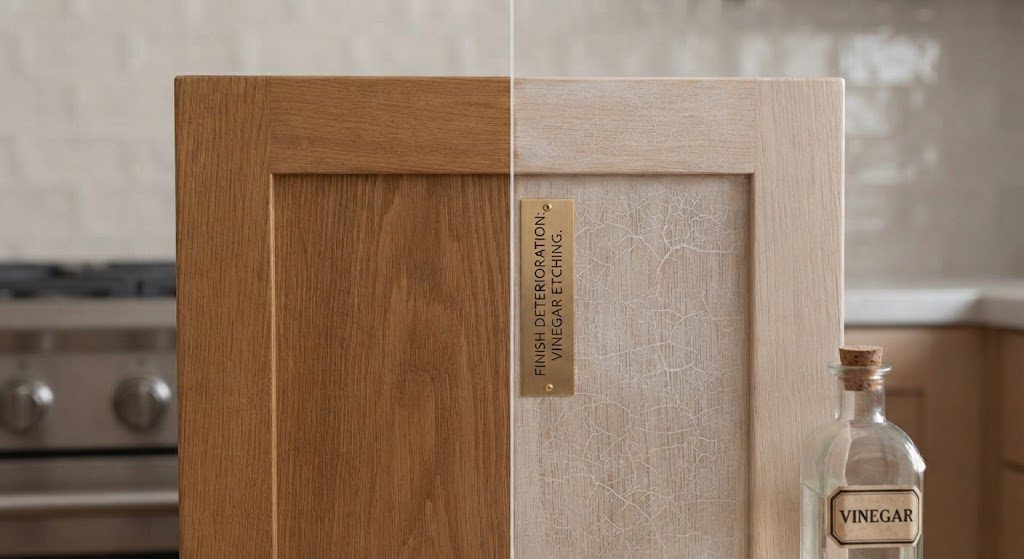
White vinegar is the most-recommended kitchen cleaner on the internet. It cuts grease, it's cheap, and it's food-safe. It is also acetic acid at roughly 5 percent concentration, which is strong enough to etch a catalyzed lacquer finish over repeated use. The first few cleanings with a vinegar-and-water solution will make your cabinets look great — the acid strips a microscopic layer of topcoat and leaves a temporary shine. After six months of weekly vinegar wipes, the finish starts to look cloudy, then chalky, and then it's worn through to the stain layer. I've seen vinegar dissolve the finish off paint-grade maple doors within a year. A $60,000 kitchen, and the cleaner cost 99 cents a gallon. The fix is a full strip and re-spray, starting at $2,500.
Steam Cleaners: Heat and Moisture Straight Into the Joints
Steam mops and handheld steamers inject 212-degree water vapor into every seam, joint, and crack in a cabinet. The heat flash-expands the wood, the moisture drives straight into exposed MDF edges and unsealed panel centers, and the result shows up weeks later as swollen door panels, raised grain on stained surfaces, and delamination at the substrate. Steam is the single fastest way to destroy an MDF center panel. It also strips the protective wax layer from conversion varnish, leaving the finish porous and susceptible to water rings. If you wouldn't steam a hardwood floor, don't steam your cabinets. The damage is cumulative and frequently irreversible without replacing the affected doors.
Murphy's Oil Soap: The Residue Factory
Murphy's Oil Soap is a vegetable-oil-based soap that leaves a thin oily film on everything it touches. Over weeks and months, that film builds into a gummy, sticky layer that traps dust, cooking grease, and airborne grime. The cabinets start to feel tacky to the touch, then they darken unevenly as grime adheres to the oil residue. Cleaning Murphy's off requires a solvent-based cleaner that risks the finish underneath. The product markets itself as "wood-safe" because it doesn't strip the finish immediately, but the long-term buildup is harder to remove than the original grease. I tell clients to throw away the bottle if it's under their sink.
The Simple Cleaning Protocol
Wood cabinets need almost no cleaning if you prevent grease buildup in the first place. Wipe the area behind the cooktop and around handles once a week with a dry microfiber cloth to catch oil mist before it accumulates. For fingerprints and light soil, dampen a microfiber cloth with warm water, wring it until it's barely damp, and wipe gently. Dry immediately with a second cloth. This is enough for 90 percent of cabinet surfaces, 90 percent of the time.
For heavier grease — the sticky film above a range — mix a drop of mild dish soap in a quart of warm water, wipe the soiled area, rinse with a clean damp cloth, and dry thoroughly. No scrubbing. No soaking. Every cleaning product should touch the cabinet for less than thirty seconds before being wiped dry. The goal is to lift grime from the surface without letting moisture sit on the finish.
The Annual Wax Refresher
Once a year, apply a thin coat of paste wax — Renaissance Wax or a high-carnauba-content furniture wax — to stained wood doors and drawer fronts. Buff it off with a clean microfiber cloth. The wax adds a sacrificial layer that takes the daily wear instead of the finish itself. Do not wax painted cabinets; the wax can build up and alter the sheen. For painted surfaces, the dry cloth and damp-water routine is all you need. If the sheen looks dull after five or ten years, a light scuff-and-recoat by a finishing professional restores it without replacing a single door.
The best cleaner for custom cabinets is restraint. Don't spray, don't soak, and don't believe the bottle that says "wood-safe" unless your cabinetmaker handed it to you personally.


No comments yet — grab the first one.