The Five-Piece Problem
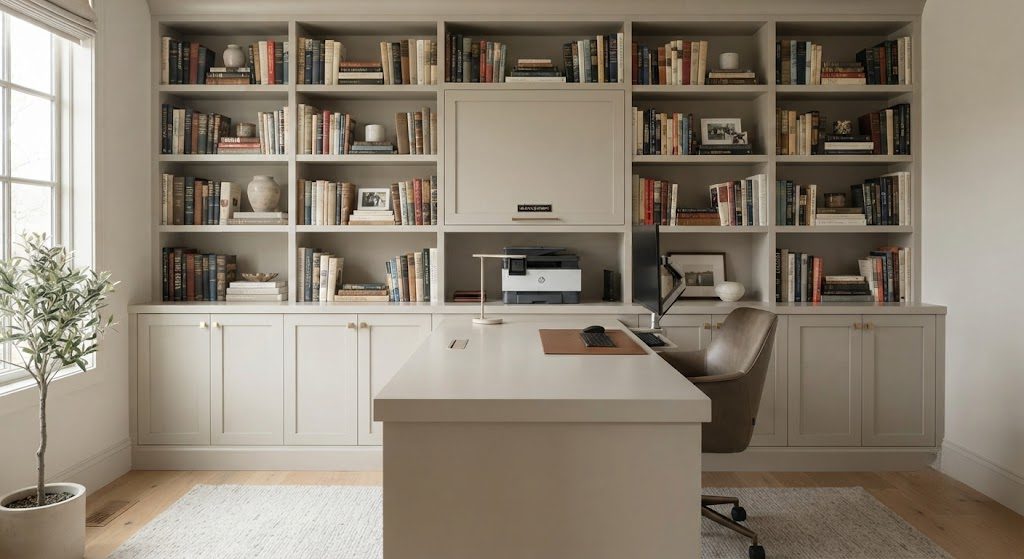
Before we touched the room, this home office was a study in clutter disguised as function. A freestanding desk held the monitor and keyboard. Two 6-foot-tall bookcases leaned against opposite walls, stuffed with 200-odd books in no particular order. A rolling printer cart sat wedged between a bookcase and the wall, power cord snaking to the nearest outlet. The shredder lived on the floor beside the filing cabinet. The router and modem perched on top of a bookcase, blinking lights at eye level, with a nest of Ethernet cables dangling down the side. Total floor area consumed by furniture: 42 square feet. Total visual chaos: constant.
The brief was direct: make it all disappear. One wall, floor to ceiling, 12 feet wide. Every function of those five pieces of furniture had to live inside the built-in, accessible but invisible.
The Technology Cabinet
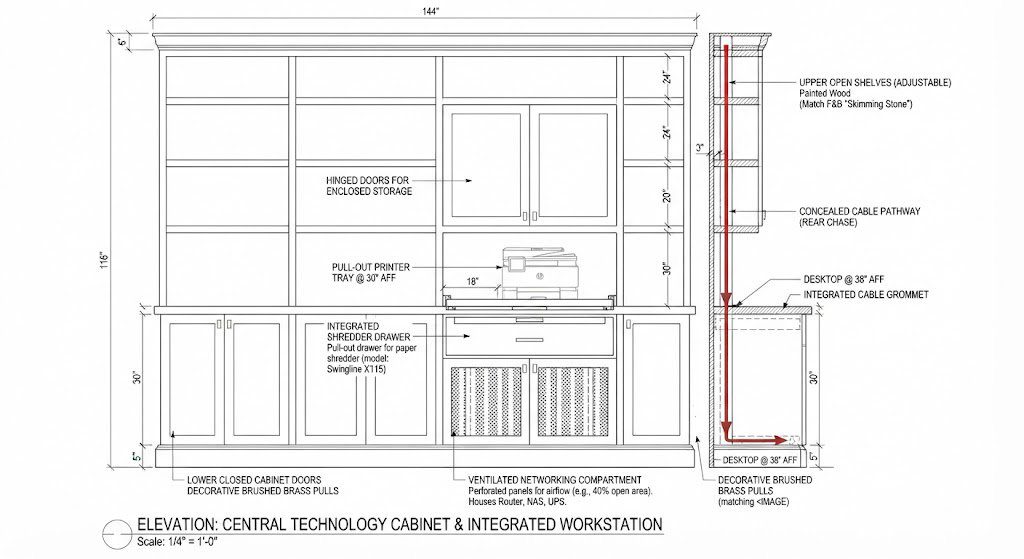
The center section of the built-in is a 36-inch-wide, full-height cabinet that looks like three stacked drawers and a pair of doors. The top drawer is a dummy front that hinges down to reveal a pull-out printer tray. The tray extends 22 inches on full-extension slides rated for 75 pounds, giving full access to the paper tray and scanner lid. Below that, the next drawer front conceals a shredder on a second pull-out, sized to catch shreds in a removable bin without lifting the machine. The bottom cabinet houses the router, modem, and a small network switch on an adjustable shelf, with a ventilation grille cut into the toe kick and a second passive vent at the top of the cabinet. Two brush-lined pass-through grommets in the cabinet back route power and Ethernet to a recessed outlet strip mounted inside.
The Book Wall and Filing System
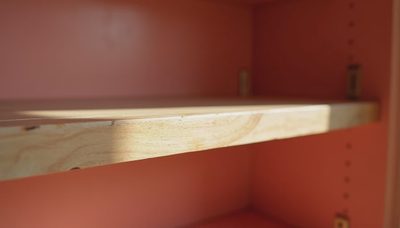
Flanking the technology cabinet are two 48-inch-wide bookcases, each with five adjustable shelves. Shelf spacing was determined by measuring the client's actual books: an 11-inch-tall shelf for art books and oversized reference volumes, a 9-inch shelf for standard hardcovers, and two 8-inch shelves for paperbacks. Every shelf is set on 5/32-inch shelf pin holes bored in 32mm increments, so the layout can change if the collection changes. The bottom 18 inches of each bookcase is a closed cabinet with a single deep drawer for hanging files — eliminating the freestanding filing cabinet — and an open cubby for the subwoofer and a backup drive, both with grommeted access to power.
The Desk as an Extension
A solid maple desktop, 30 inches deep and 72 inches wide, cantilevers from the built-in between the two bookcases at 29 inches off the floor. A continuous wire-management channel recessed into the back edge routes power, data, and a single monitor arm. The channel is covered by a removable maple strip that sits flush with the desktop surface. No cables touch the floor. The printer, shredder, and router are within arm's reach but entirely out of sight.
The Furniture It Retired
The built-in replaced two bookcases — roughly $1,600 total — along with a printer cart, a filing cabinet, and a shredder stand that added up to nearly $2,000 in furniture that would need replacing at least twice in 20 years. The built-in cost $8,600, installed, including paint-grade maple, Blum soft-close slides, and the integrated cable management. The room feels larger, quieter, and cleaner — not because the cabinetry is expensive, but because every function was planned from the studs out. After the install, the homeowner told me the first video call with a perfectly clear background wall felt like a different house entirely.


No comments yet — grab the first one.