A wall mounted bookshelf can solve a real storage problem without consuming the floor area of a conventional bookcase. But the good ones are not simply boxes hung on a wall. Their proportions, fasteners, shelf spans, and relationship to trim determine whether they look intentional or like an afterthought. After nearly two decades in a cabinet shop, I have learned that the difference is usually found in the planning, not the paint color.
For homeowners who have already outgrown flat-pack furniture, this is where a wall mounted bookshelf becomes interesting. You can buy a ready-made unit from IKEA, West Elm, or The Container Store and get useful storage quickly. You can also have a cabinetmaker build something around your actual wall, ceiling height, baseboards, and collection of books. Both approaches have a place. The mistake is expecting a lightweight retail shelf to perform like a built-in cabinet.
Start With the Wall, Not the Shelf
Measure the wall in three places: near the floor, at the intended mounting height, and near the ceiling. Older homes often have walls that are not perfectly straight, especially around corners and windows. Record the smallest width, then locate studs with a stud finder and confirm them with a small exploratory hole. A shelf designed around a stud pattern will be safer and easier to install than one forced into an arbitrary width.
Think about the objects the shelf will hold. Standard hardcovers are roughly 9 to 11 inches tall, while art books and oversized design volumes can need 14 inches or more. Leave room for a hand to reach over the top of a row. If every opening is tightly packed, the piece will be annoying to use even when the drawing looks clean.
Depth matters just as much. A 10-inch-deep shelf handles most novels and framed photographs without projecting too far into a hallway. A 12- to 14-inch depth gives more room for baskets, records, and larger books but creates more leverage on the wall fasteners. Near a desk or sofa, that extra projection can also become a sharp corner at shoulder height.
Choose Materials That Match the Load
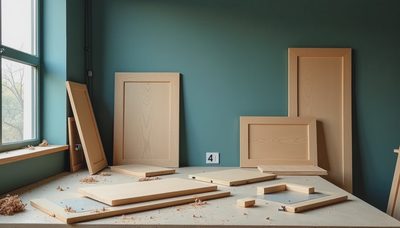
For painted cabinetry, I usually specify 3/4-inch maple plywood for the carcass and shelves, with a hardwood edge or solid wood lipping on exposed fronts. Cabinet-grade plywood stays more stable than solid wood across seasonal humidity changes, and its layered construction gives screws a dependable bite. A waterborne lacquer or conversion varnish finish is harder and more repairable than ordinary wall paint.
Melamine-coated particleboard is a reasonable budget choice for a short, lightly loaded shelf. It has a clean factory finish and is common in modular systems. The weak point is the exposed edge and the fastener connection. A long melamine shelf loaded with textbooks can sag, particularly when the mounting hardware is attached only to the panel rather than a structural rail.
Solid oak, walnut, and maple bring warmth, but solid wood moves across its width. That movement needs to be allowed for in the design. A solid walnut shelf trapped tightly between fixed sides can split or push a joint apart as the seasons change. The material is not the problem; ignoring its movement is.
The Mounting Hardware Is the Structure
A wall mounted bookshelf should transfer its load into studs whenever possible. For a heavier unit, I prefer a continuous French cleat or a concealed steel mounting rail fastened with structural screws into multiple studs. The cabinet then hangs from that rail, distributing weight across the wall instead of concentrating it at two small brackets.
Drywall anchors have their place for a narrow display shelf holding small objects, but the package rating is not the whole story. Ratings assume a particular installation and load direction. A shelf projects from the wall, so books create leverage that pulls fasteners outward. A 60-pound collection does not behave like a 60-pound picture frame.
Before drilling, check for electrical cables and plumbing, especially above outlets, sinks, and radiators. Mark the stud locations on painter’s tape, level the rail carefully, and test the empty cabinet before loading it. If the unit is installed above a sofa, bed, or child’s reading area, use a more conservative mounting strategy and include an anti-tip connection even when the primary rail feels secure.
What a Wall Mounted Bookshelf Usually Costs
A small retail shelf may cost $75 to $250, while a better modular system can run from $400 to $1,200 before installation. Those products make sense when the wall is straightforward, the dimensions are standard, and you are comfortable accepting visible brackets or adjustable hardware.
A site-built or shop-built wall mounted bookshelf generally begins around $1,500 to $3,000 for a modest single-wall project in painted plywood. Walnut, integrated lighting, doors, scribed fillers, and complex wall conditions can push the price to $4,000 or more. Installation, delivery, finishing, and site protection are real line items, not padding. In Seattle, a cabinet shop also has to account for parking, stair access, and the time required to scribe a piece to an older wall.
Ask for a written scope that identifies the substrate, material grade, finish, shelf thickness, hardware, and installation method. A $900 quote may omit painting, delivery, or proper blocking. A higher quote may include a finished end panel, a French cleat, and hours of fitting that prevent problems later.

When Custom Work Earns Its Keep
Custom work is most valuable when the wall has obstacles. A bookshelf can wrap a corner, stop neatly at a window casing, align with a baseboard, or include a lower cabinet for less attractive objects. Those details make it look connected to the room rather than placed in front of it.
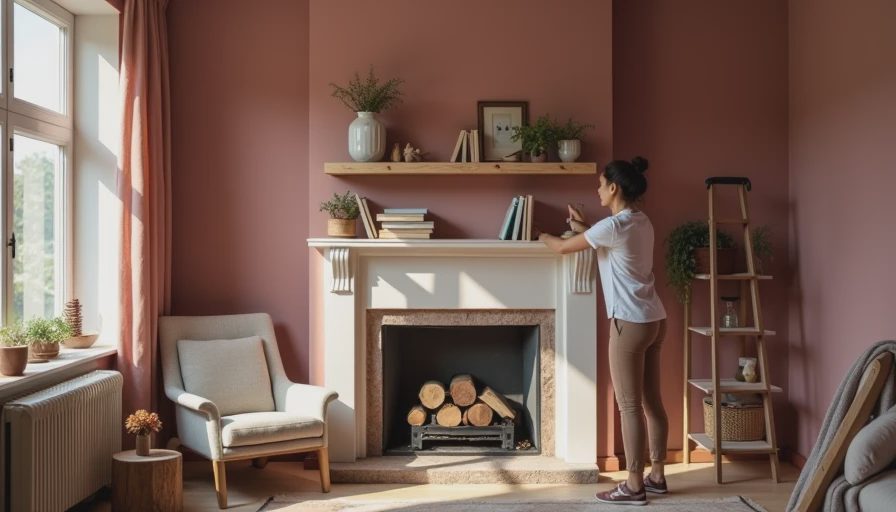
One common design is a shallow wall mounted bookshelf over a built-in desk. The lower work surface carries daily clutter, while the upper shelves hold books and display pieces. Another is a run of shelves beside a fireplace, where consistent reveals and a heat-safe material specification matter more than simply maximizing storage.
A cabinetmaker should provide a scaled elevation showing shelf openings, trim, outlets, and adjacent furniture. Ask where the fasteners land and how the piece will be removed if the wall is repainted. Good drawings answer those questions before material is cut.
A Practical Final Check
Before ordering, confirm the wall width, stud locations, finished depth, ceiling clearance, and the largest object you intend to store. Decide whether you want adjustable shelves or fixed shelves. Adjustable pins add flexibility, but fixed shelves can provide cleaner lines and more rigidity. If children or pets use the room, avoid an accessible climbing arrangement and secure every section independently.
Look at the shelf from the side as well as straight on. The best wall mounted bookshelf usually has a deliberate front edge, concealed or well-designed hardware, and a depth that relates to the room. It does not need to be expensive to be good; it needs to be correctly engineered for its load and honestly finished.
If a standard unit fits the wall and your expectations, buy one and install it properly. If the wall is crooked, the collection is valuable, or the room needs storage that connects to existing trim, get a cabinetmaker involved. A carefully measured wall mounted bookshelf can turn unused vertical space into permanent architecture, and that is where custom cabinetry earns its price.



No comments yet — grab the first one.