A wall bookshelf can be a simple place to stack novels, or it can become the piece that makes an entire room feel resolved. After building more than 120 whole-home cabinetry projects, I have learned that the difference is rarely the number of shelves. It is the relationship between the casework, the wall, the trim, the floor, and the things the homeowner actually needs to store.
The first decision is whether you want furniture that sits against the wall or cabinetry designed around the room. Both approaches are valid. A ready-made bookcase can be the right answer for a rental, a tight budget, or a room that may change purpose in a few years. A custom installation earns its price when you need difficult dimensions, integrated lighting, closed storage, or a finish that matches existing millwork.
Start with the wall, not the shelf
Before drawing a wall bookshelf, measure the full wall in at least three places. Older homes are rarely square, and a ceiling can vary by more than half an inch across a typical living room. Record the baseboard height, outlet locations, window and door casing, radiator clearances, and the depth of any nearby fireplace trim. Those details determine whether the installation looks built-in or simply pushed into place.
I generally leave a small scribe allowance at the sides and top, then cover that irregular gap with a properly fitted face frame or filler. A 3/4-inch plywood case does not magically conform to a plaster wall. The cabinetmaker has to account for the wall as it exists, not as the tape measure wishes it existed.
Depth matters as well. Most hardback books need about 10 to 12 inches of usable depth. A case that is 14 inches deep will hold larger art books but can make a walkway feel cramped. For a reading room, I often specify 11 1/4 inches inside the opening and use adjustable shelves so the owner can change the arrangement later.

Choose construction that will stay straight
For painted built-ins, my default is 3/4-inch maple plywood for the cabinet boxes, with solid poplar for face frames and door parts. Maple plywood provides a stable core, clean screw holding, and predictable edges under a sprayed finish. MDF can produce an excellent painted door because it machines smoothly and has no wood grain telegraphing through the paint, but I do not use ordinary MDF for every structural component, especially in rooms where moisture or rough use is likely.
For a clear finish, quarter-sawn white oak, rift-sawn white oak, walnut, and cherry each make a different statement. Rift-sawn white oak gives you restrained grain and a contemporary look. Walnut brings darker contrast but costs more and can dominate a small room. Cherry warms noticeably with light, so a sample board should sit in the room before you approve the stain or clear coat.
A wall bookshelf made from melamine can be a sensible utility choice. White 3/4-inch melamine is easy to clean and often costs less than veneered plywood, making it practical for a basement office, playroom, or rental unit. The trade-off is exposed edging and less visual depth. Good edge banding solves much of that problem, but it does not create the same furniture feel as a solid wood lipping or hardwood face frame.
Set dimensions around real use
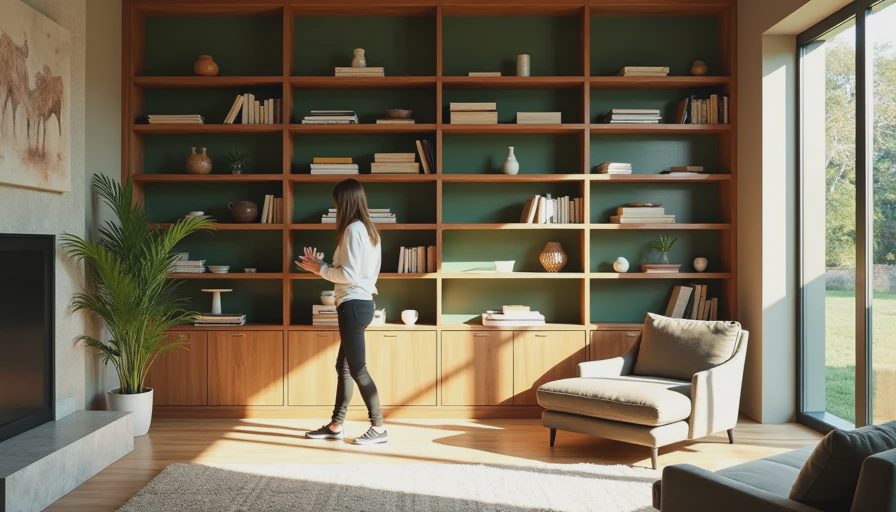
Shelf spacing should follow the objects, not a drawing convention. Paperback shelves may work at 9 inches clear, while art books and pottery may require 13 to 15 inches. If every opening is identical, you will either waste space above short books or force tall items onto the floor. A balanced elevation might use two shorter adjustable shelves above a fixed lower shelf, with drawers or doors below.
Long shelves need support. I am cautious about spans over 30 to 36 inches, depending on the material, load, and shelf thickness. Books are heavier than they look, and a shelf that sags a quarter inch will keep sagging. A thicker 1-inch shelf, a hardwood front edge, or a concealed steel stiffener can protect a long run without adding a visible bracket.
For a wall bookshelf surrounding a television, leave ventilation space and plan cable routes before the cases are installed. A recessed power and data box is cleaner than cutting holes after finishing. Keep heat-producing equipment out of sealed compartments unless you provide proper airflow; a beautifully fitted cabinet is not a substitute for ventilation.
Decide where closed storage earns its place
Open shelves display books well, but they also display dust, chargers, toys, and the stack of mail that never seems to disappear. I often combine open shelves at eye level with drawers or doors below. The lower section can hold board games, blankets, electronics, and paperwork while the visible shelves carry the objects worth looking at.
Inset doors give a more furniture-like appearance, but they demand tighter tolerances and more labor. Overlay doors are less expensive and more forgiving when a house moves seasonally. A face-frame cabinet with 1/2-inch overlay doors can look traditional, while full-overlay slab fronts create a quieter modern wall. Soft-close hinges from Blum or Salice are worthwhile in either style; the hardware costs more than basic hinges but prevents the daily slam.
Lighting is another place to spend carefully. Warm LED tape in an aluminum channel can wash a shelf without showing individual diode spots. Plan the transformer location, access, and wiring route during construction. Retrofitting lighting after the cases are painted usually means visible cords or unnecessary holes.
Understand the cost before you request drawings
A freestanding bookcase may cost a few hundred dollars, while a run of stock modular units can land in the low thousands before trim, paint, and installation. Custom wall-to-wall cabinetry commonly begins around $8,000 to $12,000 for a modest painted installation in many US markets and can move past $25,000 when the design includes premium veneer, drawers, integrated lighting, complex scribing, or extensive site work. Seattle labor and finish costs are not the same as costs in every region, but the categories remain consistent.
The largest cost drivers are usually the number of boxes, doors and drawers, finish quality, installation difficulty, and how much of the existing wall must be altered. A simple open wall bookshelf with painted plywood cases is much less labor-intensive than a full library with inset doors and fluted panels. Ask for those items to be separated in the estimate. It lets you remove one feature without throwing away the entire design.
A practical design brief for your cabinetmaker
Bring five things to the first meeting: wall dimensions, photographs taken straight on, a list of items to store, examples of finishes you like, and a realistic budget range. Include the tallest book, largest record sleeve, game console, framed artwork, or speaker that must fit. A cabinetmaker can design around actual objects far more accurately than around the phrase “lots of storage.”
Ask to see a material sample and a shop drawing showing elevations, shelf thicknesses, door gaps, base details, and outlet locations. Confirm whether the quote includes delivery, wall preparation, painting, touch-up work, and removal of old furniture. Those details often account for several hundred dollars or more.
A well-designed wall bookshelf should look calm when it is full and still look intentional when a shelf is empty. Start with the wall, choose materials that match the room's use, reserve closed storage for visual clutter, and spend money where handwork will remain visible. That process produces storage that feels like part of the architecture rather than a purchase made after the fact.



No comments yet — grab the first one.