The Tiered Reality of Custom Cabinetry
Custom cabinetry isn't one product at one price. It's a set of decisions that scale up or down based on scope, materials, and hardware. I've seen clients stretch $5,000 into a single transformative wall, and I've seen $40,000 buy a houseful of cabinets that eliminated furniture purchases for a decade. The difference between tiers isn't quality — the joinery standards and installation methods are identical across every Walker Millwork project. The difference is breadth, wood species, and the complexity of what gets built.
The $5,000 Project: One Wall, Done Right
A $5,000 budget buys one significant built-in in one room. In 2026 dollars, that means roughly 8 to 10 linear feet of paint-grade maple cabinetry with Shaker doors, Blum soft-close hinges and drawer slides, and a catalyzed lacquer finish. The scope is typically a single living room bookcase wall, a mudroom bench with cubbies and a coat rod, or a home office desk with overhead shelves and a filing drawer.
What you get: a properly scribed, floor-to-ceiling installation that fits your walls exactly. Dovetailed drawer boxes. Adjustable shelves on 32mm increments. The same hardware and joinery that go into our $40,000 projects. What you give up: stain-grade wood species, complex integrated lighting, and any room beyond the one. Finish options are limited to paint-grade — typically white, cream, or a soft neutral. No walnut, no white oak, no custom color matching to an existing piece of furniture.
The $5,000 tier is where a single problem room gets solved permanently. A couple in Ballard recently put their entire budget into a 10-foot-wide living room bookcase with closed lower cabinets for media storage. It replaced two IKEA bookcases and a TV stand, and it's the first thing you see when you walk in the door. One wall, one budget, one permanent solution.
The $15,000 Project: Two Rooms or One High-End Room
At $15,000, the decision fork appears. Option one: two rooms of paint-grade built-ins, typically a kitchen pantry wall plus a primary closet system, or a mudroom plus a home office. Option two: one room of high-end cabinetry — a stain-grade kitchen island with a waterfall panel, a full bathroom vanity wall with mirror cabinet and toe-kick drawers, or a walk-in closet in rift-sawn white oak with glass-front drawers and integrated lighting.
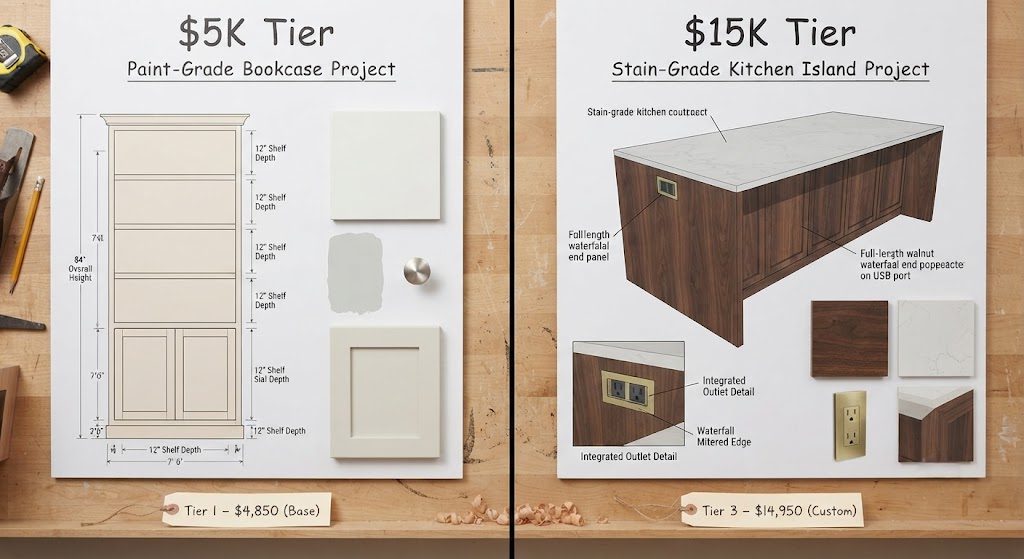
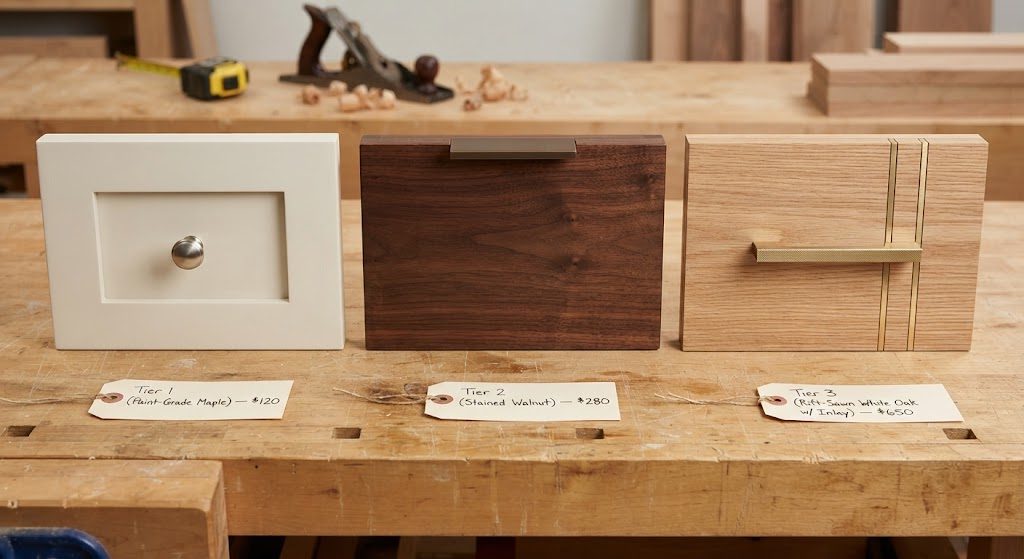
The $15,000 tier unlocks stain-grade hardwoods: alder, walnut, and rift-sawn white oak enter the conversation. Finish complexity increases — you can specify a clear conversion varnish on walnut that brings out the grain, or a custom stain match to existing flooring. Hardware upgrades become possible: Blum Legrabox drawer systems instead of standard Tandem slides, touch-to-open mechanisms on select doors, and integrated LED tape lighting inside glass-front cabinets.
What you still give up at this tier: whole-home scope. You're solving one or two rooms, not the entire house. If the kitchen gets custom cabinets and the bathrooms don't, the contrast will be noticeable. The $15,000 project is the sweet spot for homeowners who have already renovated one room and want to invest in the next, or who know exactly which two spaces generate the most daily friction.
The $40,000 Project: Whole-Home Begins
At $40,000, you've entered true whole-home territory. This budget covers a kitchen, two bathroom vanities, a mudroom or laundry room, and either a home office or a primary closet — all in paint-grade maple with mid-tier hardware throughout. If you want stain-grade walnut or white oak in the kitchen, the $40,000 budget might cover the kitchen and one bathroom, with the other rooms held for a future phase.
The shift at this tier is from individual cabinets to a house-wide storage system. Every room gets assessed as part of a single brief. The kitchen island relates to the pantry pull-outs; the mudroom cubbies mirror the bathroom vanity drawer configuration. Hardware is consistent across every door and drawer in the house — same hinge model, same slide series, same finish sheen. The result is a house where every cabinet feels like it belongs to the same family, because it does.
The trade-off at $40,000 is usually material grade. To spread the budget across five or six rooms, you stay in paint-grade maple for the carcases and doors. Exotic veneers, custom metalwork, and motorized hardware are off the table. But the scope breadth pays its own dividend: every room that gets a built-in eliminates a future furniture purchase, and the daily friction tax drops across the entire house at once.





No comments yet — grab the first one.