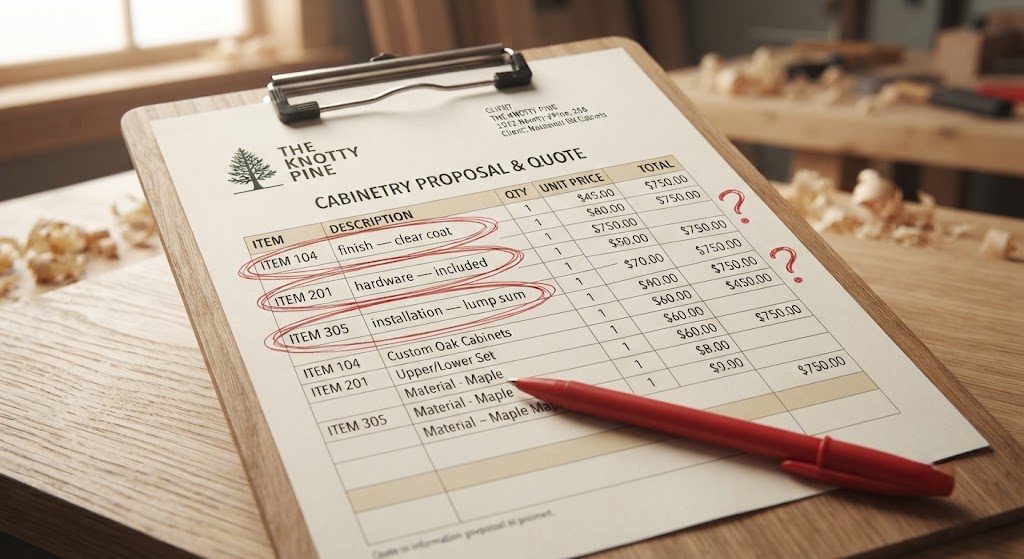
The Quote as a Contract, Not a Handshake
A cabinet shop quote is either a detailed promise or a blank check. The difference is in the line items. A good quote names every material, every hardware model, every finish product, and every phase of installation. A bad quote uses vague language that lets the shop downgrade materials mid-project without technically violating the agreement. After 19 years in the trade — first as a bench cabinetmaker, now as a shop owner — I can tell you the three line items that most reliably predict cost overruns, and the language that should make you pause before signing.
"Finish: Clear Coat" — The Biggest Red Flag on the Page
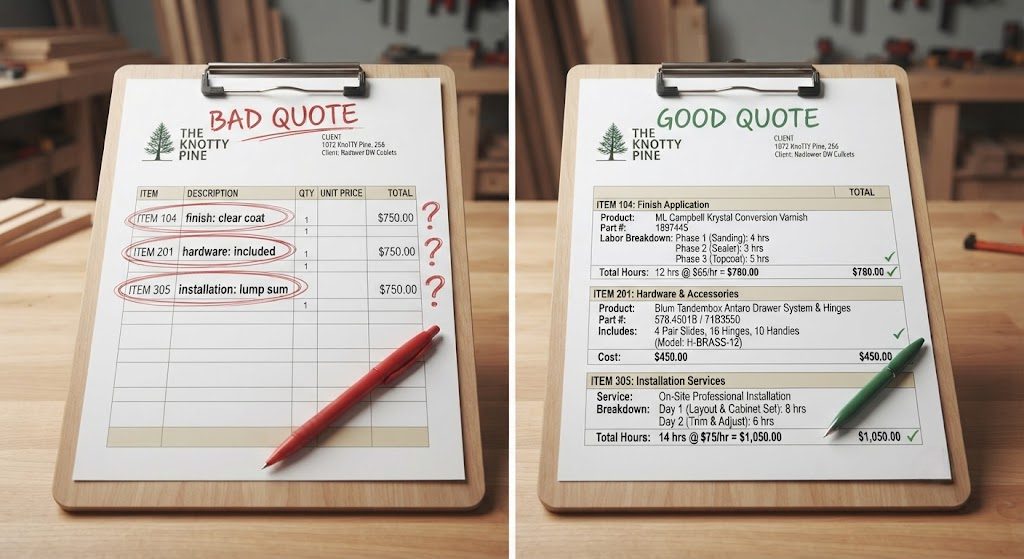
If a quote says "clear coat finish" without naming the product, the manufacturer, and the sheen, you're about to pay for the cheapest option the spray booth has on the shelf. That might be a single-component lacquer that yellows within two years, or a water-based polyurethane that leaves a cloudy haze on dark wood. Neither belongs in a kitchen.
A proper finish line item reads: "ML Campbell Krystal conversion varnish, satin sheen, catalyzed, sprayed over one coat of vinyl sealer." That tells you the exact product, the application method, and the level of chemical resistance you're getting. It also tells the shop that you know enough to check — and that's half the battle. If the quote won't name the finish, assume the shop is protecting its ability to cut costs, not your cabinets.
The same rule applies to paint-grade cabinets. A quote that says "painted finish" without specifying the primer, paint product line, and number of coats is insufficient. You want "one coat vinyl sealer, two coats ML Campbell Turbo-Cat pre-catalyzed lacquer, 20-sheen, tinted to Benjamin Moore OC-17." That specificity means the color is matched to an existing standard and the film build is thick enough to hide the grain.
"Hardware: Included" — What's Missing Is the Part Number
Hardware is the single most expensive line item you can get downgraded without noticing. A quote that says "drawer slides: included" or "hinges: soft-close" without a manufacturer name and model number is a quote that allows the shop to substitute generic hardware for the Blum or Grass you discussed during design.
The correct format: "Blum 563H undermount slides, soft-close, 100-lb rating, 21-inch length." "Blum 71B3550 Clip-Top BLUMOTION hinges, 110-degree opening, soft-close, nickel finish." Every hinge, every slide, every touch-latch mechanism should have a part number and a quantity. If the quote groups hardware into a single dollar figure with no breakdown, ask for the schedule. A 20-door kitchen with Blum hinges costs roughly $240 in hardware; the same kitchen with generic hinges costs $60. You won't feel the difference at install — you'll feel it at year five when the generics start to sag.
"Installation: Lump Sum" — Where Hidden Costs Live
Installation should be broken down by phase: delivery, site protection, cabinet setting, trim and scribing, hardware adjustment, and final walkthrough. A single line item that says "installation: $8,500" with no further detail means you don't know what's included and what isn't. Does it cover scribing the filler strips to your wavy plaster walls? Does it cover adjusting every door and drawer after the cabinets have settled for two weeks? Does it cover the return visit to touch up finish damage from the countertop installers?
A proper installation breakdown reads something like: "Delivery and carry-in: $850. Cabinet setting and leveling: $2,200. Scribing and trim installation: $1,800. Hardware adjustment and final punch: $600." Each phase has a defined scope, and anything outside that scope requires a change order. That protects both you and the shop. Without it, "installation" can expand to cover the shop's inefficiencies at your expense.
The Five Questions to Ask Before Signing
First: "What finish product are you using, and can you give me the manufacturer and product line?" If they hesitate, walk.
Second: "Can I get a hardware schedule with part numbers and quantities?" A shop that buys quality hardware is proud to name it. A shop that hides it is buying on price.
Third: "What's not included in this quote that I might assume is included?" Demo of existing cabinets, electrical work, plumbing disconnect and reconnect, and finish touch-ups after countertop install are common exclusions buried in the fine print. Ask directly.
Fourth: "What's your change-order process?" You will make changes mid-project. Every project does. The question is whether the change-order pricing is transparent or punitive. A shop should have a stated hourly rate for change-order work and a process for written approval before any additional work begins.
Fifth: "How long is the quote valid?" Material prices fluctuate. A quote that's valid for 30 days is standard. A quote that's valid for six months is a shop that's either padding the number or planning to renegotiate when lumber spikes.
A good quote reads like a technical document because good cabinetry is a technical product. If the paperwork is vague, the work will be too.





No comments yet — grab the first one.